Omnichannel marketing helps the customer by providing an end-to-end experience of easy access to all online and offline platforms, such as the website, social media platforms, mobile apps, emails, WhatsApp, offline stores, and customer services. Omnichannel marketing has shifted from being an optional trend to becoming the need of the hour. Omnichannel marketing does not mean that businesses should sell wherever they can; rather, businesses should reach wherever their customers are.
Omnichannel vs Multichannel
| Omnichannel marketing | Multichannel marketing |
| All channels are connected | Channels work independently |
| Seamless and continuous | Separate experience on each channel |
| Shared across all channels | Not shared between channels |
| Highly personalized | Limited personalization |
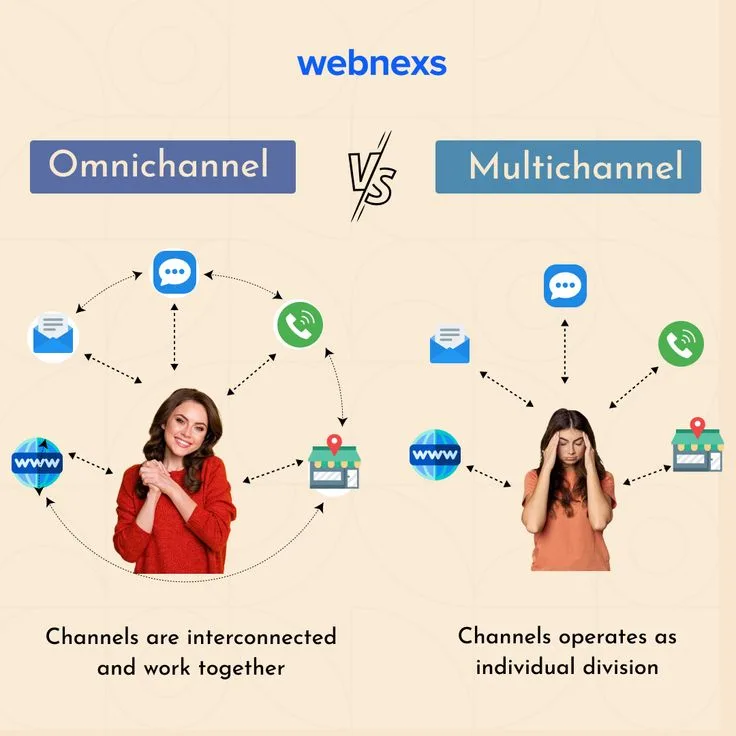
COMMON EXAMPLES:
Starbucks has its mobile application, website, and retail stores connected. This allows its customers to see reward information on their mobile application, place an order on their website, and then collect it from their retail stores. The reward systems and offers remain consistent across these platforms.
Customers can view products on a mobile device, computer, or app, and pick up where they left off. The shopping cart, as well as the search page, is the same on all devices, offering a smooth shopping experience.
Nike has its online platform, mobile app, and physical stores networked together. Customers can view on the internet, search inventory at local stores, and even use the app in the store to view sizes or styles. Everything is very interconnected.
Zomato has a fully integrated app, website, email, and notification service. Customers get exclusive offers, order foods from anywhere, track the real-time status of the ordered foods, and get updates on every platform. Customers can order products from this retailer’s online shopping portal, place orders through its application, as well as pick them up from its outlets. Customer loyalty points, discounts, and order information are consolidated whether
A customer:
1.Views your product on Instagram
A customer sees your product on Instagram, taps through to your website, adds it to their cart, gets a reminder email, and finally completes their purchase either in-store or online, all the while experiencing consistent messaging, price, and support.
2.Clicks the link and checks the details on your website
Clicks on the link and views product information on your website, adds a product to the shopping cart, compares products—ensuring a seamless brand experience every step of the way across all channels.
3.Retrieves reminder via email or WhatsApp
4.Finally purchases Online purchases In-store purchases
Key Features:
1.Consistency of message across brands
2.Customer data is shared across channels
3.Easy transition between channels
4. Hosts can stay longer in each channel
5.Emphasizes customer experiences, not exclusively sales
consistency of message across brands:
It also ensures that all of its respective communication messages from the brand exhibit a common ideology. Irrespective of how the patients communicate with their respective brands of medicines and engage with them through social networking sites of their brands or patients’ websites of their brands or their emails of brands or advertisements of their brands in their local magazines and newspapers or their patients’ support programs in their retail stores or retail stores of their brands of medicines, all patients receive a common communication message from their respective brands of medicines. All patients receive that best of their respective communication messages from their brands of medicines at all their respective touch points in order not to receive any inconvinient and confusing syndications from their brands of medicines.
customer data is shared across channels:
In relation to the concept of omnichannel marketing, consumer data is collated and shared among various channels in order to develop an entire picture among the various data of the consumers. Various types of data, such as browsing, previous purchase, preference, and previous interaction, among others, can be collected in distinct ways such as websites, social networking sites, emails, mobile applications, customer service interaction, as well as actual stores. When all the data is collated, an understanding of the demands of the consumers as well as the ability to track consumers over various interactivities for communication can be established.
Data sharing:
The company will also be able to further assist customers by providing an integrated experience with the help of data sharing. It means that customers will no longer have to re-enter the same set of information while accessing one customer point over the other. For instance, shifting from the website to support services or shifting from the website to the physical outlet. Sharing of data will enhance the services related to making decisions for the customers.
Easy transition between channels:
Smooth transition among the channels used in omnichannel marketing allows a customer to easily move from one platform to another without any hitches. A customer can begin the process on social networks, continue it on a website, and follow up the process through emails or WhatsApp messages, and finally conclude the process either online or physically. Since the channels are linked together, it means that customers’ data and activities are captured, and customers do not have to go through the process of filling out information more than once.
Hosts can stay longer in each channel:
Hosts can stay longer in each channel” means the brand or business is always there on every single marketing channel (websites, social media, emails, apps, or offline), as opposed to being there, then gone, then back again. They are engaged for a longer period on every single channel.This prolonged presence is very effective in creating an association and trust with the users since the customer gets an opportunity to be exposed to the brand through multiple instances and at their own convenience. This results in a better recall value and more engagement of customers for the brands to have a better understanding of customer activities on the online platforms.
Advantages
- Increased customer
- Greater customer satisfaction
- Increased sales and loyalty
- Strong brand trust
Increased customer:
The omnichannel marketing plan assists in boosting customers by ensuring that there is seamless and continuous experience in all online as well as offline channels. By providing multiple ways for the engagement of customers in social media platforms, websites, emails, WhatsApp, as well as offline stores, it becomes easier for the customers to complete the whole process related to buying a particular product/service related to the brand or product in which they are interested. By compiling all information regarding the customers, they can send them personalized messages in terms of promotions, discounts, or any other special offers in order to increase engagement as well as satisfaction levels. It increases credibility in front of customers that ultimately assists in retaining them whenever they make purchases. Thus, it helps in boosting the marketing plan in increasing the overall number of customers.
Greater customer satisfaction:
Higher customer satisfaction experienced as a result of achieving omnichannel marketing is attributed to the convenience of having all channels connected, allowing for a personalized experience. This is because the customer is provided with an opportunity to switch from one channel to another, which include social media sites, websites, mobile app sites, mail services, WhatsApp business sites, among others, without having to go through all the processes again. Additionally, because all the channels are connected, the company is capable of recognizing what the customer is interested in, therefore providing them with what they need.
Increased sales and loyalty:
Greater sales performance as well as loyalty, in omnichannel marketing, is therefore driven by a seamless, personalized, and consistent customer experience across all channels. The more seamlessly one can serve a brand by having continuous interaction with different touchpoints, whether it is social media, websites, emails, WhatsApp, or retail outlets, the better the opportunity of having customers place orders. Personalized suggestions and follow-through lead to more repeat business, while consistent communication leads to more trust as well as more confidence. A seamless shopping experience leads to more people staying within the shopping experience, thereby enhancing sales, as well as loyalty because customers feel valued.
Strong brand trust:
Building Strong Brand Trust in Omnichannel Marketing can be achieved by ensuring consistency in the brand values, messaging, as well as the quality of service being provided, across every possible interaction between the brand and customers on whatever channel possible. If customers experience the same brand values, messaging, and service quality wherever they interact with the brand, no matter which channel it might be, it can help in gaining brand. By supporting transparency, effective communication, and very smooth interactions, omni-channel marketing enhances relationships, improves loyalty, and converts one-time consumers into loyal supporters.
The Used Channels in Omnichannel Marketing:
- Social Media Sites (Instagram,facebook,whatsapp)
- Website & mobile app
- Email marketing
- SMS & WhatsApp Marketing
- Google Ads
- Retail outlet / Support Services